Advent/Christmas Issue
Small Fire
A Christmas Carol at Pacific Theatre
A Poetic Review by Steven Gomez
***
A candle dispels darkness
as surely as a floodlight,
small fire though it be.
Hoards of gold glint but dimly,
misers with the light.
Come in and thaw your cynic’s grin,
leave off your scoffing at old ghost stories.
While darkness might be deep,
and cold seeps in where we thought was most secure,
the Spirit also haunts the most unexpected corners.
It may be a small and single tongue of fire,
but it is flame enough for one man’s reclamation.
One man may not seem important,
but one man in his time plays many parts.
Time’s passing takes its toll even on our sins,
weakening resolve to forget the past,
melting fears of the yet-to-come,
‘til we receive the present as charitable gift.
Of all the good days in the year
(and all seven were once named good)
this one’s as good as any other
for working transformations.
Beyond the quaintness most mistake it for,
beyond the romance of London gaslight,
beyond the sentimental grime on urchins’ faces,
lies a truth as inescapable
as church bells ringing changes:
All you need to dispel darkness
is a hat, a door, some boxes,
words that have burned strong across three centuries,
and a candle.
A Christmas Carol, adapted by and starring Ron Reed, runs until Dec 21. Tickets available at pacifictheatre.org
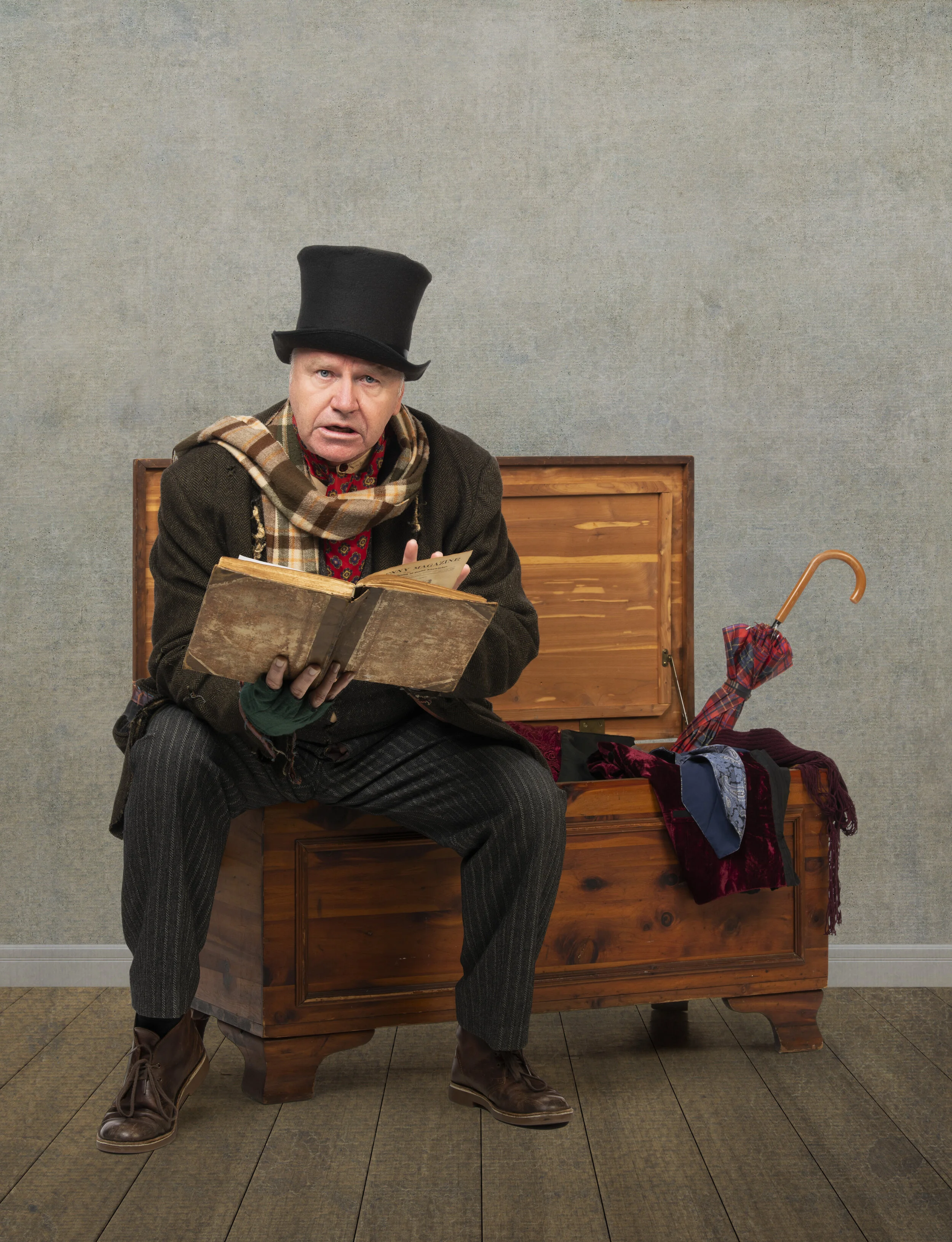
Photo by Emily Cooper
Poetry Travels
Unrequited Love and Advent Longing
By Jolene Nolte
***
“If equal affection cannot be,
Let the more loving one be me.”
W.H. Auden, “The More Loving One”
“No, when longing comes over you, sing the great lovers: the fame
of all they can feel is far from immortal enough.
[…]
Ought not these oldest sufferings of ours to be yielding
more fruit by now? Is it not time that, in loving,
we freed ourselves from the loved one, and quivering, endured:
as the arrow endures the string, to become, in the gathering out-leap,
something more than itself? For staying is nowhere.”
Rainer Maria Rilke (trans. Leishman and Spender), Duino Elegies, “The First Elegy,” 35-36, 48-52
Though in many ways I may rightly be called a Romantic, I’ve never liked the story of Romeo and Juliet and other tales of tragically frustrated love. It’s not that I can’t relate—it’s that I can. Thwarted love feels like death. Any lovesick teenager can tell you that. I don’t find anything salutary from stories that simply convert that internal death into an external event. The true difficulty, where the rebuffed (or bereaved) one’s imagination needs help, is in carrying on.
Auden’s “The More Loving One” is helpful here. The poem’s speaker does not present himself as a victim. While you’d expect that the rejected one has the greater suffering and therefore occupies the losing side of the equation, Auden flips that assumption on its head. The rebuffed one is “the more loving one,” and that means he is in the better position. The poem, which I commend to you to read in full, uses the experience of looking at the stars as a metaphor for unrequited love. The speaker realizes that while he admires the stars that “do not give a damn,” “I cannot, now I see them say / I missed one terribly all day.” His life goes on. He concludes that even if the stars were to entirely disappear, his life would still go on, and he’d eventually feel the sky’s “total dark sublime.” In the face of the beloved’s indifference or even total absence, the speaker’s capacity for admiration grows. There are real albeit painful virtues to being the “more loving one.”
Rilke’s “The First Elegy,” from his complex and much-beloved Duino Elegies, commends “the great [read: unrequited] lovers” as people we can learn from. Yet while he praises them for their depth of feeling, the questions he poses challenge the reader to press beyond those stories into the nature of existence. Ever on the search for external images to articulate inner states, Rilke uses the metaphor of an arrow in flight for someone whose love propels her out of herself, even beyond her beloved. Perhaps love, even when it’s returned—though perhaps easier to see when it is not—is indicative of the “overthrownness” of our existence. Love throws us out of ourselves, sends us hurtling into what is beyond our control. Love dispels the illusion of autonomy. Greatness, Rilke’s lines suggest, is not in self-enclosed autonomy but in the propulsion of love that moves someone beyond herself towards her beloved and even beyond. Perhaps romantic love is but one expression of this human capacity to become “something more than itself.” Perhaps it produces its best fruit when it is not conceived of as an end in itself, and that is why, in some ways, unrequited love makes that dynamic clearer: The unrequited one’s love is left in motion without the beloved to absorb it. Yet what is that motion headed towards? Rilke’s Duino Elegies strains to even gesture towards an answer.
I find myself thinking about these poems as Advent arrives again. Advent—that schizophrenic season the church calendar tells us is about cultivating longing coupled with cultural practices, stories and songs that emphasize having. This year, Auden and Rilke have me thinking that the phenomenon of unrequited love, of not having, has something to teach us about what it means to be human, about this capacity to grow in longing—not as a blight to be avoided but as something to be embraced. This Advent, Auden and Rilke help me to reframe some fresh and lingering disappointments into wondering how these experiences might bear some fruit, might launch me on a trajectory beyond myself, beyond any one person. How do my own individual longings become relativized by greater longings? Perhaps this unmet desire for requited love is one (albeit multi-faceted and sharp—I don’t mean to overspiritualize) expression of longing for shalom, for a world we can now only strain to imagine where all is made right, where each of us can ever extend beyond ourselves and be met not with indifference or resistance but with welcome—fully known, fully ourselves. I long for that day. Even so, come Lord Jesus.
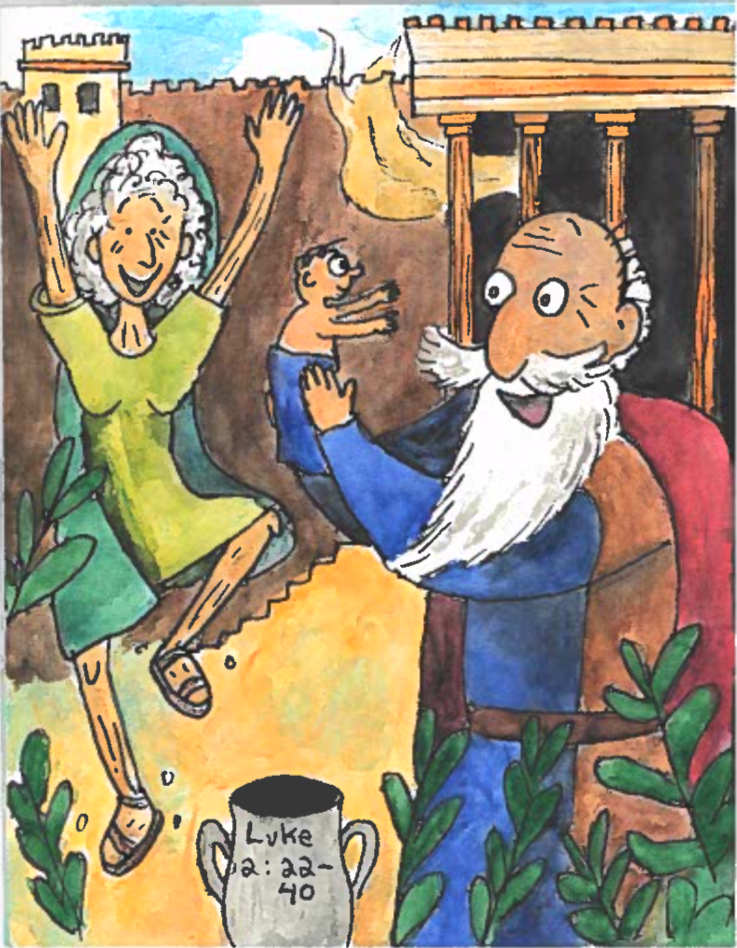
‘Simeon & Anna’
Artwork By Erica Bowler
Advent
By Alice Hodgkins
***
In this story, as in most,
things have dissolved to a sorry state.
Power in the wrong hands, taxes and fears rising,
kind words few and far between, such long nights,
home not feeling very homelike.
The characters here are all bleary-eyed,
wicked at worst, managing to trust at best.
Certainly no one knows the way,
not Herod or Zachariah or Joseph or even Mary.
Except God, who in ecstatic confidence
looks over the whole mess,
announces, The Moment Has Come,
and begins with a baby.
Oh Yes, he says, his voice bursting jubilee at the seams,
and follows this with great figures of power and light
who come down blazing and singing out loud—
not to save, fight, set right, though,
but to praise God for the infant—
and then go back, the heavens closing dark behind them.
And we are all left with a tiny warm body in the straw:
God-in-flesh,
who looks fragile like hope,
who must be held, fed, sung over,
brought back safe to wherever the little home sits in Nazareth.
Drunken Christmas Cake
***
Ingredients
1 cup of water
1 cup of brown sugar
1 tsp salt
lemon juice
4 large eggs
Lots of nuts
2 cups of dried fruit
1 bottle whisky
Instructions
Sample the whisky to check quality. Take a large bowl, check the whisky again. To be sure it is the highest quality, pour one level cup and drink.
Repeat.
Turn on the electric mixer. Beat one cup of butter in a large fluffy bowl.
Add one teaspoon of sugar. Beat again. At this point it's best to make sure the whisky is shtill OK.
Try another cup...just in case. Turn off the mixerer.
Break 2 leggs and add to the bowl and chuck in the cup of dried fruit.
Pick fruit off floor.
Mix on the turner.
If the fried druit gets stuck in the beaterers pry it loose with a sdrewscriver.
Sample the whisky to check for tonsisticity.
Next, sift two cups of salt. Or something. Who careshz.
Check the whisky.
Now shift the lemon juice and strain your nuts.
Add one table.
Add a spoon of sugar, or somefink. Whatever you can find.
Greash the oven.
Turn the cake tin 180 degrees and try not to fall over.
Don't forget to beat off the turner.
Finally, throw the bowl through the window, finish the whisky.
Fall into bed.
CHERRY MISTMAS!