
Fall Issue 9
What Words Mean
By Débora Raimundo
When I was a child, there was no Sunday school in our small village. But one day someone offered me a ride to town, so I could go to church with other kids. I remember being a little nervous and excited about it, because my mom had told me about her Sunday school and I knew they had colouring books. And I remember that at the end of the class someone gave us a little paper with the prologue of John’s Gospel and asked us to memorize it. We would even win a prize if we did so! I did memorize it during the week. I loved particularly the third verse: “All things were made through him, and apart from him nothing was made that has been made” (but of course it was in the João Ferreira de Almeida translation). (The week after that we memorized Ecclesiastes 9:1. I still wonder if that one set me on the path to Existentialism… Not sure! But please, please, please don’t make your kids memorize Ecclesiastes 9 without a proper explanation. Spare them.)
Many years later, I found myself as a Portuguese teacher in a Timorese High School. I have many regrets about the way I did things while I was there. The biggest one is probably busyness. I had a very important job to do, you see? I remember being annoyed every time a student or a colleague knocked on the door with a question or with simply a smile and a hello. “Things to do! I have important things to do!” I would think, and fake a smile back. One day, I was doing my very important job and someone knocked on my door (again!) It was one of my best students, Natalino. His name probably means that he was born around Christmas day—or Natal in Portuguese—because that’s how people are named over there. He bowed his head a little, asked for permission to enter, extended his hand to me and took it back to his chest as everyone does in Timor when they want to greet you with the highest respect. Then he sat in front of me and spoke in Portuguese: “I need to ask you something.” He looked directly at me, which was not as common in the culture. “I want a book in Portuguese. I want to learn how to speak and read better, but I don’t have any books, and I would like to have a book at home, so I could read after school.” At that point I had received dozens of books from my generous friends in Portugal, but I had given them all away or put them in the school’s library, which the students were not allowed to take home. I didn’t have any more books to give! But then I remembered: “I have… I only have… this New Testament.” I opened my drawer and took one of the Gideon’s New Testaments a pastor had sent me from Portugal. Natalino extended his arm immediately: “Yes, thank you!” (No, in East Timor you would not get in trouble for doing this as a teacher. The country is 97% Roman Catholic and I cannot tell you how many quarrels between students I solved by talking to them about God’s forgiveness and love. Perks.)
A few months later, Natalino knocked on my door again. He took the New Testament from his backpack, and although he might have been careful, it already looked used. When he opened it, I was sure: the little book was filled with written notes on the margins. And if you have ever held a Gideon’s New Testament you know that the margins are not big enough. “Can you help me?” he asked. I noticed the big crucifix on his neck and said: “Yes. What is it?”
“This is a marvellous book. Marvellous! I particularly loved the Gospel of St. Luke. But now I cannot understand this. I’ve tried… but I can’t.” He opened the book in the Gospel of John and turned it to me. “Can you? Can you explain it to me?” Yes, of course I could. “From the beginning?” I asked. Then I started, word by word, translating the Gospel of John from Portuguese to Tetun: “Iha prinsipiu iha liafuan. Liafuhan ne’e ho Maromak, no mos liafuan ne’e mak Maromak.” Natalino was too respectful to stop me and tell me that was not what he meant. But when I asked: “Do you see?” He took the opportunity to clarify: “No… I don’t need you to translate it for me. I understand all the words! I don’t understand the meaning.” Oh… that! I honestly cannot remember what I explained to him at the time. I remember mentioning Logos and Greek philosophy, but I am not sure if my explanation would be good enough to pass a New Testament exam at Regent, (I suspect not,) but he looked satisfied at the end and told me: “Yes, I believe this.”
The other day, I realized I could read the prologue of John’s Gospel in Greek, because I almost understand all the words now. I was thrilled! But do I really know what the words mean? I like to think I do. But I would also like to know that when I am not certain about something, I would be honest about it, like Natalino was with me, knock on someone’s door, and ask. Every time I read those verses now I remember they were the first I memorized as a child and they were the ones Natalino sought to understand better. And I am reminded that knowing and understanding are not always the same thing, and that absorbing the truth is certainly a different thing. I’ve read somewhere that John Stott used to say that the Biblical mind is not a mind stuffed with verses, but the one which has absorbed biblical truth so thoroughly that it is able to view every issue from a Christian perspective.
That is why I hope we memorize, understand, and absorb the Word for the glory of the Lord.
Home
By Naomi Pattison-Williams
The way the wind teases the clothes line—
a thrift store skirt (the one with purple flowers),
dish towels and bright baby blues
all lifted gently by summer’s breath. The way
the billowing sheets smell like the sky.
The way your sleepy babe, heavy with content,
falls off the breast as you absorb the light parting
of his lips, the milk which pearls at nipple’s tip.
The way the true words of a friend
pierce morning’s fog to call you home.
The single peony head which, when rescued
from the pile into this clear glass jar, bursts
into second glory toward the afternoon light,
her bright petals ablaze with a delicious,
extravagant, magnificence.
BC Hikes
By Heather Kaufmann
Three B.C. day hikes to add to your bucket list*
Cypress Mountain (West Van)
Just 45 minutes outside of Vancouver, Cypress offers a variety of trail options of varying lengths and difficulties. We started our hike at the ski lodge and made our way to St. Mark’s Summit via the Howe Sound Crest Trail. On a sunny day, you’ll see fantastic views of Horseshoe Bay and Bowen Island from the summit (or on a rainy day, like when we hiked it, you’ll see lots of clouds!). Works well as a half day hike for varying abilities.
Panorama Ridge (Garibaldi, Whistler)
A well-beloved hike, this one summits with a stunning view of Garibaldi Lake (google it – it’s bright turquoise!). Very manageable, albeit monotonous, switchbacks characterize about 6 out of 10 hours of this out-and-back hike, but it’s well worth the alpine beauty and close-up views of Black Tusk you’ll find once you’re past them. You might also consider taking a detour on your way back down from the summit to dip your sore toes into the ice cold lake.
Skywalk North Loop (Whistler)
This hike is a bit off the beaten track, and you may be more likely to encounter a bear than a fellow hiker along the way, but after the steep climb at the beginning, it’s nonstop panorama mountainscapes for the rest of the way. You can catch glimpses of Rainbow Glacier all along the route until you reach its base, where you can gape directly up at the waterfall that splits the vast gray stone down the middle. Takes about 10 hours with some good rest stops mixed in. We went in July, and made good use of our hiking poles to keep us upright through the icy bits!
*You may want to hold off on trying out these hikes until April or May of next year; for now, just let these mountain daydreams motivate you in your rainy day studies ;)


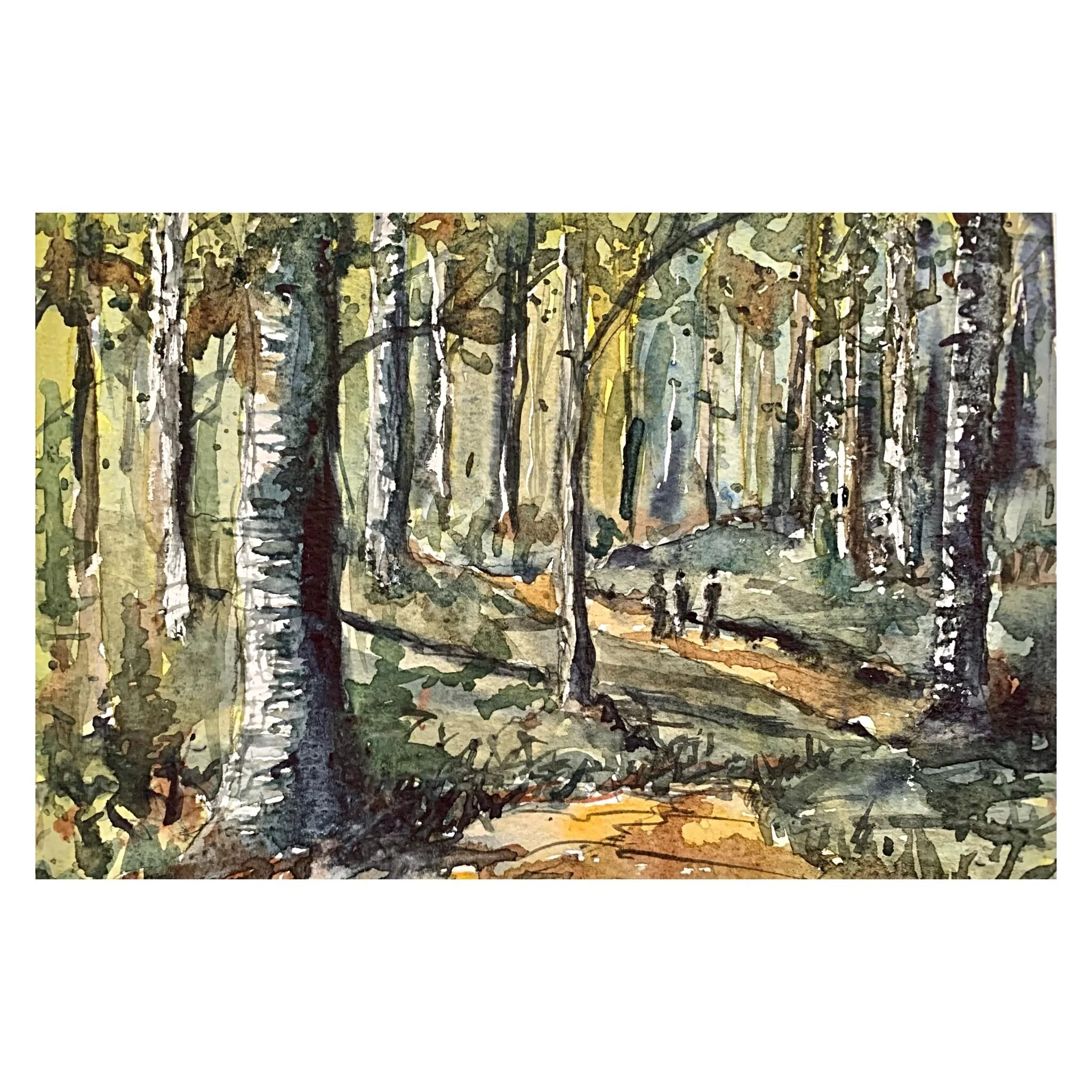
“Three Walkers”
Paul Spilsbury
If you feel like responding to any of this week’s articles or artwork, feel free to write a letter to the editor by clicking the link below.