
Fall Issue 11
Even Covid can’t stop Regent from being Regent. - Saana Walker
Click here to download a PDF of this issue. Click here to download the Greensheet.
Against Marilynne Robinson
By Alex Strohschein
Did you know that there are talented Christian novelists living today who are not named Marilynne Robinson (or Wendell Berry)?
I do not intend to cast aspersions on Robinson - she is rightly recognized as one of the most eloquent novelists alive today, exploring religious themes in a world that is secularizing and often apathetic to Christianity. Here is a Calvinist who has excelled at her craft and received the adulation of a wide audience (including one famous fanboy). I was glad to have the opportunity to hear her speak at the 2017 Laing Lectures and I had the pleasure of reading her newest novel, Jack, a few weeks ago.
But Robinson has joined the coterie of Christian novelists, the usual suspects, that Christians always appeal to - G.K Chesterton, C.S. Lewis, Flannery O’Connor, Walker Percy, John Updike. Again, these writers are wonderful - Chesterton and Lewis were my gateway into theological thinking and their works continue to influence me (in undergrad a few friends and I even started a Chesterton Club).
But there are other Christian authors out there who are alive today - hooray! Some notables besides Robinson are Lee Smith, Leif Enger, Tim Winton, David Adam Richards, and Eugene Vodolazkin.
My favourite is Alice McDermott. It is strange to me that she does not have a fervent following among Christians - or at least evangelicals. Unlike Robinson, she hasn’t penned copious essays where she muses on Calvin, humanism, and politics (though next year McDermott will release a collection of essays on writing). True, she is Catholic and her novels centre around Irish-Catholic families in mid-twentieth century America, but again, many of the “usual suspects” were Catholics like O’Connor and Percy. McDermott is not a “rad trad” - you get the sense that she has a more progressive vision for the Catholic Church than O’Connor, including a New York Times piece where she calls for the ordination of women to the priesthood. She has been a finalist for the Pulitzer Prize three times and won other prestigious literary awards.
McDermott writes about ordinary people and gives voice to how they experience the world as believers. Responding to a question posed by Image she reflects, “I have used Catholicism simply to give my characters a vocabulary that they might not otherwise have. These are people who would not know how to give language to their experience, who would not know how to say, ‘There’s got to be something more than this,’ or ‘I’ve found something more than this,’ if they couldn’t also say ‘redemption’ or ‘ascension’.”
McDermott’s characters draw comfort from their faith. In Charming Billy, one character muses on her parents’ faith:
“It made it easier that they both believed in the simplest kind of afterlife - that my father could say to her, even in those last days, joking but without irony, 'You're going to get tired of hearing from me. I'll be asking you for this, that, and the other thing twenty-four hours a day. JESUS, you'll be saying, here comes another prayer from Dennis.' And my mother would reply, her voice hoarse with pain, 'Jesus might advise you to take in a movie once in a while. Give your poor wife a rest. She's in heaven, after all.'
It was a joke, but they believed it...There was, in their anticipation of what was to come, a queer self-satisfaction. It was clear now that they would love each other until the last moment of her life - hadn't that been the goal from the beginning? They would love each other even beyond the days they had lived together; was there any greater triumph?”
Beyond McDermott, I have found there are individual novels that touch on faith - their authors may not write prolifically or even be Christian - but they still are worthwhile to read. I think of Bo Giertz’s The Hammer of God (lauded by Leland Ryken as “the best Christian novel you have never heard of”), Shirley Nelson’s The Last Year of the War, Jamie Quatro’s charged Fire Sermon (that made me blush) and Christopher Beha and Michel Faber, whose The Book of Strange New Things is one of the best novels I read all year (the latter two are lapsed Christians). Some Christian academics have even written fiction, including Michael Bird’s The Divinity School and Bill Svelmoe’s Spirits Eat Ripe Papayas.
Sometimes I think I just want to out-hipster the Christian hipsters. Marilynne Robinson and Sufjan Stevens are not normal fare among evangelicals and deserve their followings, but they have become staples among Christian hipsters. It is in Christian hipsters’ ontology to find less well-known figures to plug. So if you finished Gilead and ask yourself, “What am I going to read After This?” remember that Someone recommended Alice McDermott to you.
The Centre of the Rose
By Steven Gomez
Who can peer into the centre of a rose?
A tightly coiled and loaded spring;
That hidden point from which all grows.
Petals lock the door shut closed,
The flower’s heart encloistering—
Who can peer into the centre of a rose?
Some secret key the bee must hold
To nectar’s source, the life wellspring,
That hidden point from which all grows.
The Florence poet in heaven’s throes
Found his desire’s full flowering
And peered into the centre of that rose.
He saw the saints in blessed glow
All dancing the Empyrean ring
Around the point from which all grows.
The one who travelled hell’s dark roads
And from the mountaintop kept climbing
Peered into the centre of Love’s rose,
That hidden point from which all grows.
The Wounded God
A Reflection on Art and Lament
By Davi Rabelo
When you pass through the waters, I will be with you; and when you pass through the rivers, they will not sweep over you. When you walk through the fire, you will not be burned; the flames will not set you ablaze. For I am the Lord your God, the Holy One of Israel, your Savior. . . . Do not be afraid, for I am with you (Isa 43:2–3, 5).
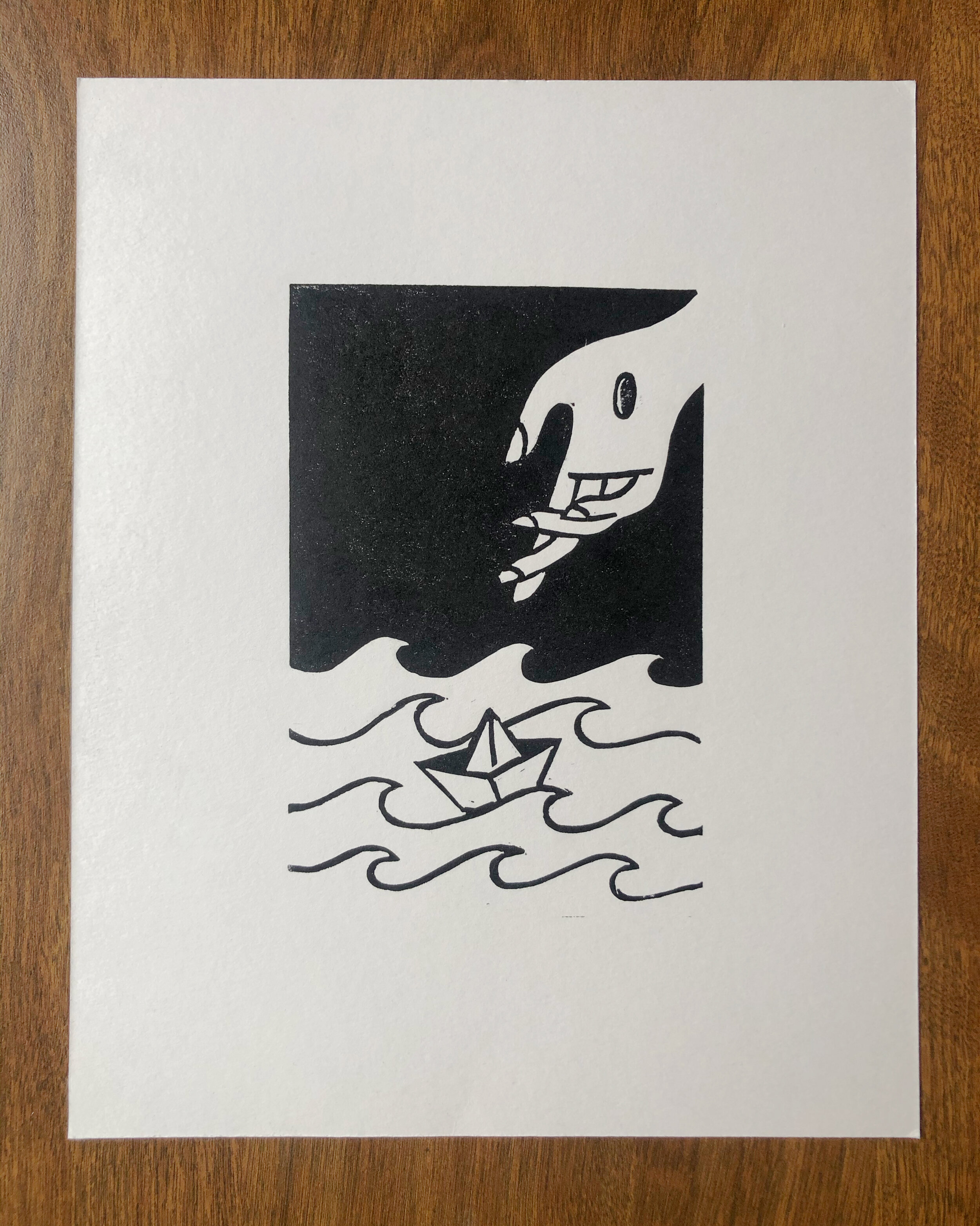
The print below is one I made a month ago after saying goodbye to a very dear friend. He passed away of cancer at the age of forty-one, way too soon in our own eyes. We had just watched the memorial service online and inspired both by it and by Isaiah 43, I decided to do this linocut. This was a mere attempt to express some of the emotions, sorrows, and hopes in the face of that tragic reality. For some doing art is a form of relieving stress or relaxation. This is usually not the case for me. Prayers and struggles often accompany the creative process, as it reminds me of my limitations. Moreover, it often leads me to deeper reflections on the purpose of beauty, pain, and how God finds us amid this broken world.
During this time of pandemic, one of the talks that has inspired me was by James K.A. Smith on why art matters during a pandemic. In it, he discusses the role of art in reshaping our imagination to rebuild a flourishing society. So not just producing art, but experiencing good art can help us to attend to the world and help us cultivate a sense of transcendence. For him, if “we’re going to imagine the world otherwise, we need imaginations that are trained in subtlety, that have been humbled by mystery, and that are infused with infinity.” In his view, art should attend to the brokenness and beauty of the world, and we need both for a meaningful life. It reminds us what it means to be human, to experience sorrow, and to long for restoration. C.S. Lewis is a master in this regard. In The Magician’s Nephew, Digory is worried about his sick mother and pleads with Aslan for help. And Lewis describes Aslan as having tears as big as Digory’s and at that moment he realizes that the Lion loves his mother as much or even more than he does. It is the tears of God that bring comfort.
I recall in my orientation week, it was said that our Regent journey involves many great experiences but also deep sorrows. Three years since then, I can attest to that and I am sure that many of my Regent fellows can as well. Our family has lost many loved ones during this period, and we were not able to say goodbye to most of them due to the huge distance from home. Timothy Keller asserts that one of the main metaphors that the Bible gives us for facing affliction is walking. Suffering is something that we must walk through, as we see in passages such as Psalm 23 and Isaiah 43. As Keller points out, for many ancients, suffering was something that they should withstand and endure without feeling and fleeing. However, many modern Western people view it as something that can be avoided, such as bad weather. Living in Vancouver, you quickly learn that you cannot escape bad weather. You just have to deal with grey, dark, and rainy days. Similarly, pain is unavoidable and death is an inexorable reality. This reality we must face “without shock and surprise, without denial of our sorrow and weakness, without resentment or paralyzing fear, yet also without acquiescence or capitulation, without surrender or despair.” (Keller, Walking with God Through Pain and Suffering) Our comfort and hope is the realization that we are not in it alone. God also faces the waves, the fire, and darkness with us.
This time at Regent has taught me the place and importance of lament in our spiritual life, lament not just as a personal experience, but as a communal exercise. To rejoice with those who rejoice, mourn with those who mourn. We are grateful that here we found people to rejoice with, to laugh and celebrate with, but also to mourn with. Through the language of the psalmists and biblical prophets, we can give voice and expression to grief, regret, lament, and hope. Moreover, here I have learned that the arts can also be a powerful expression that attends to our brokenness and transcends it. Not so we can escape this reality, but to face it with a renewed sense of faith and imagination, knowing that Christ is with us.
To see more of Davi’s work, follow his Instagram page: @davirabelo
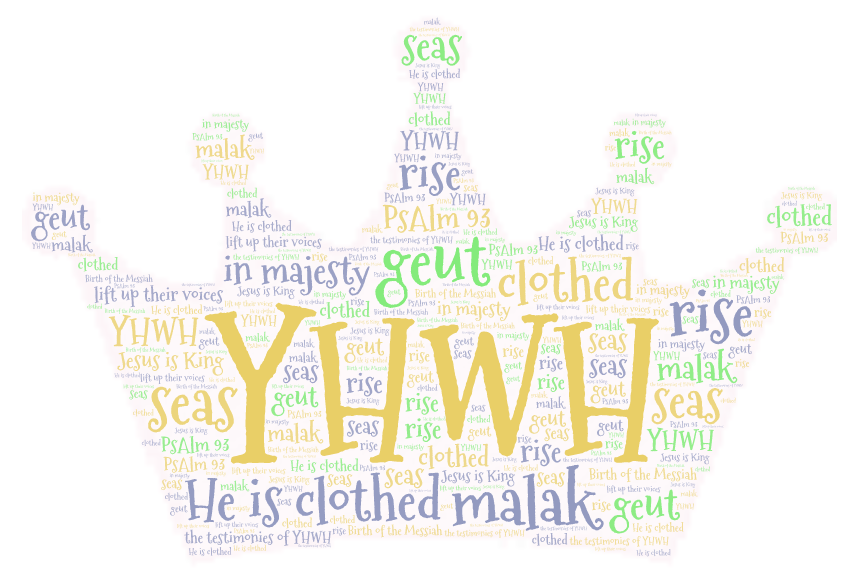
Word art based on Psalm 93
By Amos Bohoussou
If you feel like responding to any of this week’s articles, feel free to write a letter to the editor by clicking the link below.