
Winter Issue 5
Mystery, Rigour, and Spaciousness
Why Theology Students Should Come to a Poetry IPIAT Presentation
By Jolene Nolte
I came to Regent for poetry. Now, that’s not the only thing I came to Regent for, but the idea that I could learn about theology and write concurrently was a chief reason I uprooted myself and showed up in Vancouver. I know this isn’t the typical reason folks come to Regent, but for me, developing a writing practice has been an essential component of my studies. I see poetry and theology not as opposed but as deeply interconnected.
I don’t know about you, but I’m drawn to laughably huge questions like “What does it mean to be human?” and “What is freedom?” I turned to theology, philosophy, and poetry to explore these questions. While I found a conceptual framework to think about these questions valuable, in the quiet of my soul, it’s poetry that both takes hold of me and seems to bubble up from me. In my studies here, I found I needed poetry like I needed food. As Kierkegaard writes, poetry plunges us “into the complex centre of life” (Purity of Heart is to Will One Thing, 115). Theology talks about God, but poems (like Hopkins’ “Thou Art Indeed Just, Lord”) talk to God—in palpable abjection, in accusation, and in trust. Poetry can allow us to hold room for all these things because it is at least sane enough to recognize that we cannot explain everything.
The rigours of writing poetry help to clarify my thinking. A common misconception I encounter in talking to folks about poetry is that it is primarily therapeutic. It certainly can be therapeutic, and many of my poems are transparently personal, but writing a poem, if it’s any good, involves much more than emotional release. Poet Rachel Zucker talks about poetry as an act of translation. How do you articulate an experience into words on a page that then form a different experience for your reader? Are the sounds, denotations, connotations, and etymologies of these words true to the experience?
To quote another writer, Alice Hodgkins, “Poems are about surprises.” Writing a poem often takes me somewhere I did not expect, but in revision, I ask myself about the nature of the surprise and its connection to where I started. What is central? What are the relationships between the parts of the poem? How does this word, this metaphor, this line break relate to the rest of the poem? This requires a contemplative level of attention. Poems are, therefore, most often slow-brewed affairs even if they are articulating an experience of an instant. Yet for all its demands, poetry opens up space as well. Poems invite us to slow down and pay attention, to enter the world of the poem, and perhaps return with something unexpected—a deepened insight, a new way of perceiving. This is all predicated on the reader’s willingness to participate and ask some of those same questions of the poem—How do these connect? Why this word?—in order to make those connections for herself.
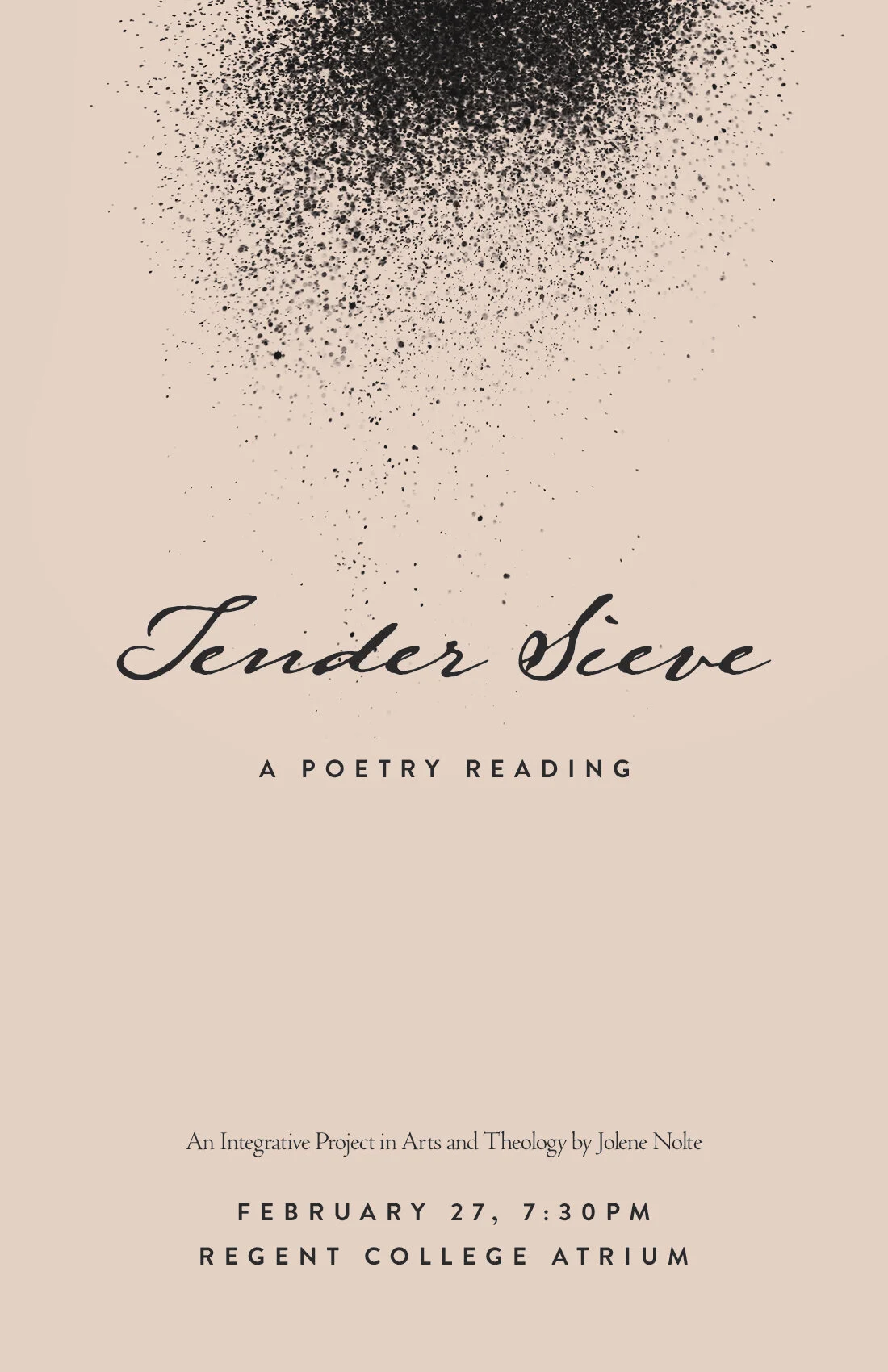
I know poetry isn’t everyone’s thing, and I also realize many of us don’t know how to enter it because of lack of exposure (or unpleasant exposure in grade school). Even so, I believe that as human beings—and perhaps particularly as theology students—we need poetry to teach us to embrace a more contemplative way of being, one that acknowledges mystery, that makes space for thought and feeling, heady concepts and visceral experience, and that delights readers while requiring their participation. That’s what I’ve been aiming for as a student-poet in these last three years. I hope you come on the evening of February 27 to hear more. I’ll talk a bit about a theology of freedom and what that might mean for poetry, but mostly I will read some poems from my IPIAT collection, Tender Sieve. My hope is that the evening will serve as a sample of poetry doing some of what I’ve just described. Come ready to think, to feel, to listen and enjoy, and to question.
The Leap
By Jolene Nolte
Sixteen, at summer camp, I stood
at tower’s edge in cloudless
sky-height, wooden-jointed.
I stared down at The Blob: oblong,
blue-and-yellow inflatable
bobbing on the lake below.
Others coaxed and coached,
but only I could leap. Within me
stirred a noisy council: To jump
is to be out of control—the thought
supplied its own evidence, visions
of broken bones. Yes, but others
can do it, why can’t I? The tower
swayed, the lake shimmered,
The Blob continued to bob, and I
stood still.
Then rose—whence I do not know—
a decisive determination urging,
Stop rehearsing. Finally
I took a few steps back
for a running start, finally
flew off the platform, joints
and spirit consenting to bend.
My stomach rose as I plummeted,
wind roaring in my ears.
My aim was poor, feet only
skimming The Blob as I lurched
and sank into the cool lake.
No matter—I emerged new
from the encompassing blue.
While You Were Sleeping
By Bryana Russell
In the past two years I have often returned home to a familiar, yet surreal, sight. My father – who has convinced my children he is 100 years old – will be puttering in the kitchen, making final preparations for dinner. Rambunctious children run from room to room (a distance in our small townhouse of a mere 20 feet), eager to release their post-school wiggles. And sat at our dining or kitchen table are my mother and our adopted yet rent paying son and friend, who, for anonymity’s sake, we’ll call Joe. (For visual clarity, the kitchen and dining room table are one and the same, but referenced specifically depending on the situation, eg. “Boys, please don’t dance on the kitchen table, you’ll spill your cereal” or “Dear guests, let us move to the dining room table to begin our feast by candlelight.” Language matters, friends.) Joe and my mom, who, for aforementioned anonymity’s sake, will remain known as my mom, are enjoying a glass of red wine. Each. Conversation jumps in the excitement of the after school/work reunion. As dialogue moves seamlessly between the predatory practice of bull-sharks, the merit of diverse theological voices, the chance of precipitation (my father’s steadfast contribution), and a quiz to determine if you are Jar Jar Binks or Darth Vader, my mother will giggle, “We’re having a while-you-were-sleeping moment.”
For those of you in diapers when the Sandra Bullock film While You Were Sleeping was released in 1995, it is the story of a woman who becomes part of a multi-generational, interconnected, chaotic and compassionate family through a serendipitous series of events. In its hilarity and bedlam, it tells of a re-imagining of kinship. Loneliness calls forth welcome, fullness, creates space — rather than constricting and causing tightness — and family grows.
I anticipated learning a great many things here at Regent, but I could not have known how my understanding of family would change. In an excellent book, The Ethics of Everyday Life, Michael Banner articulates the Christian reconfiguration of traditional kinship, physically, spiritually and economically. My, or rather our, lived life, with my husband, parents, three boys and Joe, in a 1300 square-foot four-bedroom townhouse (you do the math) has reflected a great deal of his assertions. Contrary to popular belief, our lack of space has not restricted our happiness, but multiplied it instead. In sharing life’s messiness with someone whose loyalty isn’t founded in shared genes or a public proclamation of ‘I dos’, I have come to understand more fully the connectivity and mercy of the body of Christ. The newness of fast friendship blossomed into the familiarity of habitually shared experience. We witnessed the fullness and crowding create expansion. Confinement enlarged our heart space, and walls fell down. Walls of insecurity, fear of judgment and self-protection tumbled on down.
And so, like the movie While You Were Sleeping, a stranger named Joe (who I at first believed to be a pompous Brit, perhaps related to the Royals) has come to be part of our family through a serendipitous bottle of Crabbies and an orientation BBQ. But the end has come. As with any good party, at table, the wine glasses now sit empty. Still, I hear the reassuring voice of Mother Mary remind me, “Whatever He tells you, do it.” For Christ desires to offer fullness and transformation. And though Joe has left, we retain his gift and Christ’s grace of transformation: a new understanding of kinship. We wait expectantly for our glasses to be filled again, ready to toast an excellent Regent learning indeed.
A Christian Life in Five Objects
(or, Four Books and Some Beads)
By Steven Gomez
I hope I’m not too much of a consumerist, but I do place value on things. It’s hard not to as a human being; our lives often depend on objects. And since God not only created the material world but has also walked around in it, wearing flesh and blood and using the object of the cross for our redemption, it’s hard to not place value on certain things as a Christian.
The metaphor of a journey is a popular one for the Christian life. Not because we are journeying away from materiality, but because our temporal existence gives us beginnings, middles, ends, and the inescapable sense of movement towards God. Like any literal journey, we need things to help us travel. I’ve found five objects that have helped me greatly on my spiritual voyage. Think of them as cardinal points of a compass; they’re directions to face, places to stop and rest, baggage to hold ourselves.
At the centre of the compass is my newest object: a loop of beads and a small wooden cross. I wrote about my prayer beads at the beginning of term, so suffice it to say here that prayer is my orienting axis. It connects to all the other objects because at some point it is done in conjunction with all of them.
On the eastward point, where the sun rises and the day begins, is my Bible. The melding of divine revelation and human creativity, it teaches me my heritage and origins of faith. My copy has extra wide margins to note down what I’m studying about its history and culture as well as how I’m responding to what I read.
On the southern point is a simple notebook—my private journal. I write down my ideas, dreams, and thoughts as I travel. Sometimes I take to the random creativity of drawing or doodling. I use it to grow in awareness of the Me whom God created.
On the northern point, counterbalancing myself, is a copy of St. Augustine’s Confessions. At least that’s what’s there right now. The Church whom God has created are my fellow travellers and family, and growing reconciled to God means growing reconciled to each other: community. St. Augustine is someone who wrote a book not to show off or wallow in self-pity, but to say that he’s been there and done that and would you like to travel together for awhile?
Finally on the westward point, the sun’s direction of travel, is my single-volume copy of The Lord of the Rings. Tolkien heard the call on every Christian to love and converse with the world. He did not always love what the world did—nor do I—but he loved what the world was: God’s creation. Not simply nature, but also culture and language and the beauty we all contribute, Christian or not.
Prayer. The Bible. The Self. The Church. The World. Five objects of the Christian life, represented for me by four books and some beads.