
Fall Issue 1
I’m looking forward to all the quotes! - Vivian Lee
Click here to download the PDF of this issue.
From the Editor’s Desk
Changes and Constants
By Steven Gomez
You know, it’s funny. While it isn’t the September I was hoping for back in February, it’s also not quite the September I was dreading by the middle of March. I’d rather have Zoom—awful as it is—than no class at all. Books and even study spaces aren’t completely inaccessible. It turns out I can see friends in person and even have lunch with them. Why, as I’m writing this I’m sitting in the Regent library, of all places.
There’s even still a student newspaper to edit, which means I have a job. And better yet something to welcome you to as we begin another term. Welcome to a new season of the Et Cetera. There are some exciting changes ‘under the hood’ this year, starting with the hiring of two fantastic associate editors: please welcome Alice Hodgkins and Amy Deutscher to our editorial staff! Expect to be hearing from both of them very soon. They might even ask you to write something for us.
Something that should be clear: with building access largely limited, we won’t be printing the Et Cetera for this term, and probably the rest of the year depending on what happens. But fortunately we’ve always had an online presence here at rcsa.regent-college.edu/et-cetera, where you can read everything from every issue. We’re also adding a PDF version each week to preserve something of the print format if you’re pining for the pre-pandemic days, or want something that’s a little easier to flip through. (Check out the link above.)
We’re also expanding our horizons in terms of content. While articles and poetry will continue to be the mainstay of this little paper, we know the pressures of school and the apparent pressure to write some meaningful reflections for the Et Cetera are competing—and we know the pressure that comes with grades attached will win. So while I love articles, I also want to reassure you that other things are more than acceptable too. Small things like a list of hikes you would recommend, or pubs you enjoy, your favourite music to study with, a picture you took this week. All these things are more than okay to submit. And we can do pictures and artwork in colour now! Just be sure that it’s a nice, high resolution.
If there’s one thing I know about Regent, it’s that some of us know how to cook, so watch this space for some recipes now and again. Or are you one of those blessed with a green thumb? Feel free to share any gardening tips you might have to help the rest of us fulfill our creation mandate. And if you’re in need of a little help or advice—or a laugh—send in a question for our Dear Crabby column (check out a sample further on).
Hopefully that sparks some ideas for you. So if any of that (along with the articles and poetry) strikes you as a way you’d like to contribute, send it on over to etcetera@regent-college.edu.
I hope that, despite the mental and emotional challenges you’re probably facing this season, you are still looking forward to Regent life. Because there is still so much to look forward to even as there’s so much we miss. One of those things is right here: the Et Cetera. It will be here for you to read over your own lunch after chapel every Tuesday if you like, just as it’s always been. So until next week: Stay kind, stay calm, stay safe—and stay tuned.
Intellectual Work
Prescriptions from A.G. Sertillanges
By Mike Evanson
The beginning of a Regent College school year is both exciting and nerve wracking. At this time of preparation and anxiety, I offer a combination of personal thoughts (as a returning student) and some excerpts from some summer reading: The Intellectual Life, by A.G. Sertillanges. Sertillanges, a Dominican monk, explores both the theoretical and practical elements of pursuing intellectual work. Since as students we are all doing intellectual work, his words are relevant to us all and the beginning of the year is a great time to gain perspective and to develop some new habits.
1. Plan wisely
“You must study yourself, consider what your life is, what it enables you to do, what it furthers or excludes, what of itself it suggests for the hours of intense activity.”
The school year will demand much of your time and energy, on top of whatever else your life consists of. Plan your semester. Do it early before the semester gets away on you. Find an organizational system (there are dozens out there) that works for you. It is an investment of time which will more than pay for itself.
2. Simplify your life.
“Simplify your life. You have a difficult journey before you – do not burden yourself with too much baggage.”
If it feels like your schedule is too full, it may actually be too full. Consider what isn’t necessary and cut it out. Be realistic with your time. Also, keep in mind that this is only for a season, only for a time so that you can dedicate as much as yourself as possible to your studies.
3. Maintain a Devotional Life.
“Study is itself a divine office, an indirect divine office; it seeks out and honors the traces of the Creator, or His images, according as it investigates the nature of humanity; but it must make way at the right moment for direct intercourse with Him.”
I know it is hard to set aside consistent time for prayer and the disciplines of the spiritual life while studying at Regent. Nonetheless, study and the devotional life go hand in hand. Attempting to make progress in studying without an active relationship with God is, according to Sertillanges, like thinking a “stream will flow better if its spring is cut off.”
4. Do not neglect other responsibilities.
“The good is the brother of the true: it will help its brother. To be where we ought to be, to do what we ought to do, disposes us for contemplation, and feeds it.”
It may be that you need to cut some responsibilities out of your life in order to dedicate the time needed to study. Indeed, it can be easy to see other responsibilities as detracting from our intellectual work (I am guilty of this). Sertillanges encourages us to see the connection. The one feeds the other, “the good is the brother of the true.” Doing the good, and fulfilling the responsibilities of the rest of life, will actually enhance and not detract from your studies.
5. Involve Others
“We never think entirely alone: we think in company, in a vast collaboration; we work with the workers of the past and of the present.”
Sertillanges goes to great lengths to counter the idea of the isolated, individual intellectual who has no need of others. Find some meaningful connections at Regent and agree to be intentional about supporting each other in studying. Outside of school, share your vocation as student with your spouse, close family member or friend. It will bring you together, lighten your load, and make it easier for your loved ones to make the sacrifices they are probably making for you to study.
7. Look after your body
“Your intelligence takes your other faculties into partnership; your soul uses your body; your personality, its outside contacts; all these things together make up your thinking being.”
Sharing a sentiment that is truly Regentish (one could imagine Jens Zimmerman saying this), Sertillanges stresses the connection between body and mind. Take care of your body; It is part of your “thinking being.” Look after it. Plan a way to get some exercise and eat well.
8. Study outside your discipline.
“Every branch of science pursued home would lead to the other sciences, science to poetry, poetry and science to ethics and to politics and even to religion.”
Regent’s programs offer the opportunity to specialize in many areas. Specialized study can be a disadvantage, however. For Sertillanges this is because all disciplines are connected: “No branch of knowledge is self-sufficing; no discipline looked at by itself alone gives light enough for its own paths.” So, lean into those courses you must take that aren’t in your area of interest. You never know how they may inform and transform you.
The war creates no absolutely new situation; it simply aggravates the permanent human situation so that we can no longer ignore it. Human life has always been lived on the edge of a precipice. Human culture has always had to exist under the shadow of something infinitely more important than itself. If men had postponed the search for knowledge and beauty until they were secure, the search would never have begun. We are mistaken when we compare war with ‘normal life.’ Life has never been normal.
—C.S. Lewis, “Learning in War-Time,” in The Weight of Glory, and Other Addresses
Quarankus*
By Heather Kaufmann
*a sampling of the daily haikus I wrote while in quarantine upon returning to Canada for the fall term.
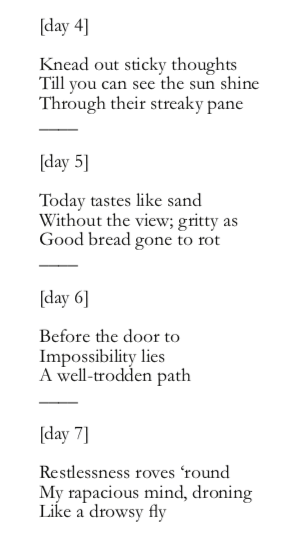
Dear Crabby
Dear Crabby,
Why does my housemate suck and leave me unable to explore other breweries?
Dear Stuck Alone At The Brewery,
Have you considered being more fun?
Love,
Crabby
Now more than ever, when we’re distanced and apart, we need to remember the ties that bind...
Tie Tuesdays!
Clean up your Zoom game, at least once a week, by wearing a tie for chapel and any classes you might have on Tuesdays. Just because you can wear the same t-shirt three days in a row doesn’t mean you have to!
Sport your necktie, bowtie, ascot, scarf, pirate frill, Elizabethan ruff, or whatever. Don’t know how to tie one? YouTube has tutorials, so that’s no excuse.
On your bare neck with that three-day-old t-shirt is fine. Let it be formal, let it be funny, let it be gender inclusive. Just let it be here still!
One-Pan Pasta
From Mary Frances Giles
Hi friends! If you're anything like me, you spent the summer living off of cheese and crackers, chips and salsa, and ice cream. But just because fall is here and we need to act like responsible adults again doesn't mean we need to spend tons of time in the kitchen. After all, all of our time is about to be ripped from our hands anyway! Here's one of my favorite recipes: it's quick, tasty, cheap, and easy enough for even a beginner cook.
(Adapted from Martha Stewart and Food52.com)
Prep time: 10-15 min Cook Time: 20 min Serves: 4
12 ounces linguine
12 ounces cherry or grape tomatoes, halved or quartered if large
1 onion, thinly sliced (about 2 cups)
4 cloves of garlic, thinly sliced
1/2 teaspoon red pepper flakes (from MFG: this definitely adds a kick, so use less if you don't like heat)
2 sprigs basil, plus torn leaves for garnish
2 tablespoons extra-virgin olive oil, plus more for serving
Coarse salt (from MFG: table salt is fine here)
Freshly ground black pepper
4 1/2 cups water
Freshly grated Parmesan cheese, for serving
1) Combine pasta, tomatoes, onion, garlic, red pepper flakes, basil, oil, 2 tsp salt, 1/4 tsp pepper and water in a large straight-sided skillet or pot (linguine should lie flat).
2) Bring to boil over a high heat. Boil mixture, stirring and turning pasta frequently with tongs or a fork, until pasta is al dente and water has nearly evaporated, about 9 minutes. (Note from MFG: Yes, it does cook all together in the same pot! But don't skip the stirring/turning or the pasta will stick to the bottom of the pan)
3) Season to taste with salt and pepper, divide into bowls. Season to taste with fresh basil, olive oil, and/or grated parmesan as desired.
Enjoy!