
2022 Winter Issue 4
““...okay but actually which VeggieTales character would make the best spouse?””
Approaching Great Lent, Fasting, and Disordered Eating
Rachel Hart
If you’re like me, prior to coming to Regent, you’ve maybe heard the word before, or have a few Catholic friends that complain about what they can and cannot eat around this time. High school was the first time I “practiced” lent and did a social media fast. But I didn’t really understand much about why every year for thousands of years, Christians have spiritually dedicated themselves to preparing for Easter. Lent is the season in the church calendar based on Jesus’ 40 days of fasting and prayer in the wilderness. In this time, we journey with him towards Jerusalem, towards Golgotha, and ultimately, towards resurrection. Traditionally, Lent is practiced in the church by three ‘pillars’: fasting, prayer, and almsgiving. Fasting, however, is the one that is most well- known, most observed, and most misused. As someone who struggles with disordered eating, this season has been a challenge to me over the last few years. As good as the spiritual discipline of fasting is, I’ve learned one main thing over the past few years: you cannot fast from food if you have an eating disorder. Seeking healing and wholeness is the good and right priority to have. And you are not practicing a ’lesser’ Lent in not fasting from food.
St John Chrysostom has an incredible sermon, “On Fasting,” that I highly recommend everyone read. He uses the analogy that fasting is like medicine for the soul, “medicine, as beneficial as it is, becomes useless because of the inexperience of the user. ...if one who is going to heal the body needs so much accuracy, when we care for the soul...it is necessary to examine and observe everything with every possible detail.”
The point of fasting is to re-orient us to God, to see where our lives have been led by other things that battle to control us, and to give those up to God. Anyone who has pursued recovery for their eating disorder is already walking that journey. Eating disorders disrupt the lives from those who suffer from them by obsessing over food, what can or cannot be eaten, what to eat next, what to do to one’s body because of the food eaten, in a non-stop cacophony. Recovery from an eating disorder pushes back, reclaiming control in a healthy mind. What a healed person practices in their fast, an individual with an eating disorder practices daily: you (food) do not have control over me, God is the source of my life and health.
And the fasting we do for Lent, while practiced with food, is never limited exclusively to food. In Isaiah, God clearly states the priority of fasting: for the good of your neighbour, to break the bonds of oppression (Is. 58). Chrysostom again identifies this, saying that if your fast is only in the food you
eat with no effect on other parts of your life (your eyes, hands, legs, hearing, all the other ways you experience the world) then you’ve missed the point of the fast. This is the same principle that St. Paul addresses in 1 Corinthians 13— whatever grand spiritual practice you might do, without love, is worthless. Fasting is a good spiritual discipline that helps us to clean the windows of our soul to see the Beloved more clearly (to borrow an example from Bruce Hindmarsh). But
it is not the only way,
“for there exist, there really exist, ways which are even more important than abstinence from food which can open the gates which lead to God with boldness. He, therefore, who eats and cannot fast, let him display richer almsgiving, let him pray more, let him have a more intense desire to hear divine words. ... Let him become reconciled with his enemies; let him distance from his soul every resentment. If he wants to accomplish these things, then he has done the true fast, which is what the Lord asks of us more than anything else”
Lent is not a ‘second new year’s resolution’. It’s not a trendy diet the church does every year to put off a few pounds. It is not a season where everyone is judging you on your weight. It is a season where we are taking time as a church to look inward. To see our need for our Saviour and come to him in repentance, and confidence, knowing his grace and mercy are more than we even ask for. It is a time where we are looking forward in hope, carrying the weight of the world’s griefs, our griefs, knowing that resurrection is coming.
As we approach Great Lent this year, let me encourage you. If you are healthy to and so inclined, fast with great sincerity, seeking the good of your neighbour and love of God. If, however, like me, there is healing still needed whether in mind or body, be gracious with yourself entering this season. Continue to commit yourself to prayer. Give generously in service or almsgiving as you are able. If you are in a stage of healing where you can’t fast from food, just simplify it, rather than do away all together. For me, that will be eating very simple small breakfasts every day. It will mean less sugar in my tea. But it will also mean not skipping meals. This is a communal practice we are entering, so share with each other your burdens. It is not pharisaical for you to share recipes, have each other over for meals, or to talk about what you’re struggling with. May this season of prayer and lament cultivate a desire for peace and justice in the world. And may this season of fasting help foster a deeper craving within you for Christ.
__________
(Non)Place
Russell Dueck-Price
I remember being six years old. Well, I should say, I remember being a 6-year-old with a Nintendo 64. There’s very little of being a six-year-old that I actually remember. But I do remember this: I turn on the Nintendo 64 that my sisters and I received for Christmas. We have one game, its Super Mario 64 (that part is important). Princess Peach reads a letter, and there is a long panning shot of the castle yard. Over the moat, under the bridge, and down a path. Mario emerges out of a pipe. It’s a visual that is so well known to me I’d consider it a formative memory. Almost as if I truly lived it. I take control of Mario and sprint toward the castle. I’m stopped in my tracks. There’s a tutorial, but I don’t read it; I’m six.
The door to the castle opens, and Mario politely closes the door behind him. Then a sound echoes out. It’s a terrifying sound, like electric guitars, but unearthly, and unreal. Following this is the sound of menacing laughter. A moment of quiet. Regal music begins to play, I am supposed to feel like I am in a place of prestige as this, of course, is where Princess Peach lives. Royalty lives here, supposedly. But they don’t. A great unease fills me. I stand in the doorway of an immense empty structure. I know what I am supposed to do. I am supposed to go to my left and take on the Bob-omb Battlefield, but I don’t. I just wait. There’s something eerie and unsettling about this castle. The low poly graphics, the repetitive music, the emptiness, its not right. There’s no furniture here, there’s no rooms like how we, us, human beings have rooms, it’s just emptiness. This place feels weird because it’s a (non)place, it’s not real. I don’t mean that it’s not real because it’s a video game rendering of a make-believe castle, I mean, it doesn’t even represent that. It’s just a staging area. There’s no history here, there’s nothing about this (non)place that says, “these walls have stood here for centuries.” It’s soulless. This place was created the moment I turned the Nintendo 64 on. I’m creeped out by this castle, it makes me uncomfortable. My skin is crawling, I feel paradoxically claustrophobic and agoraphobic at the same time. Of course, I don’t think any of this, I’m six years old.
I remember being seventeen years old. Well, I should say, I remember being a seventeen-year-old with a ticket to see UnderOath. There’s very little of being a seventeen-year-old that I actually remember. But I do remember this. I just left the show at Red’s in West Edmonton Mall. It’s 1:00 AM and my ears are ringing (that part is important). There’s a general rush to get out of the humid and sweaty room. I’m drenched in sweat (my own as well as that of complete strangers). I have all the markers of a seventeen-year-old scene kid in the 00’s: black jeans, band t-shirt, couple of wristbands, and black Chuck Taylors. It’s February, so we don’t go outside. We stay in the mall. I think my dad is going to pick us up. We begin walking. There’s a conversation happening, but as the crowd dissipates, I am hit with a realization: The mall is empty. We are in the largest mall in North America, and it’s empty. It’s the largest and emptiest mall in North America. I’m in it, so there’s at least one person. But I don’t count. I don’t need to squeeze by myself. I don’t need to apologize for being in my own way. My friends are ahead of me, and I look back toward the Santa Maria. It’s a replica of Christopher Columbus’ ship. It’s in this empty mall. The place feels weird because it’s a (non)place; it’s not real. I don’t mean that it’s not real because it’s a replica boat in an empty mall, I mean, it doesn’t even represent that. It’s just an empty mall. There’s no history here, there’s nothing about this (non)place that says, “this boat has stood here for centuries.” This place was created the moment I walked out of Red’s. I’m creeped out by this mall, it makes me uncomfortable, my skin is crawling, I feel paradoxically claustrophobic and agoraphobic at the same time. Of course, I don’t think any of this, I’m seventeen years old.
(Non)Places are devoid of history, they seem to call back to some idea of history, but they themselves can never capture it. They exist as a representation of a like-thing (a replica if you will). Chain-stores are (non)places; they all resemble the same thing, the same layout, the same aesthetic, the same store. There’s nothing to them other than the buying and selling of goods or the movement of people. They’re soulless and only when they’re occupied by people do they seemingly have any sort of heartbeat or life to them. Sometimes you go to a place, and it feels old. It’s haunted, not in the spectral sense, but that its history looms over it. We bathe in this feeling; it speaks to us. We become nostalgic. Weary for the past, for a time that once was. History gives it character; it gives it a soul.
We live in the era of (non)places. Sometimes it feels as though there are no places left, we exist merely in transition between (non)places. Then I begin to wonder if the loss of place will result in (non)people. Unable to recall our history, existing as a representation of a like-thing.
Editor’s note: the concept of a (non)place is developed and explored by anthropologist Marc Augé in “Non-Places: Introduction to an Anthropology of Supermodernity” (1995).
__________
Canvas
Hanna Löffler
Bin ich das Bild, dann bist du der Rahmen.
Kann mich bei dir ganz neu entfalten.
Bin ich die Farbe, bist du die Leinwand.
Probiere was neues, was bisher noch keinen Platz fand.
Bist du die Leinwand, bin ich die Farbe.
Blühe bei dir auf und endlich kommt mein ich zu Tage.
Bist du der Rahmen, dann bin ich das Bild.
Hälst mich aus, begrenzt mich, du gibst mir Stabilität.
If I am the painting, you are the frame.
With you, I can bloom in a whole new way.
If I am the paint, you are the canvas.
I’m trying something new, that couldn’t find its place yet.
If you are the canvas, I am the paint.
With you I begin to flourish and finally, my true self becomes clear.
If you are the frame, then I am the painting.
You carry me, limit me, you give me stability.
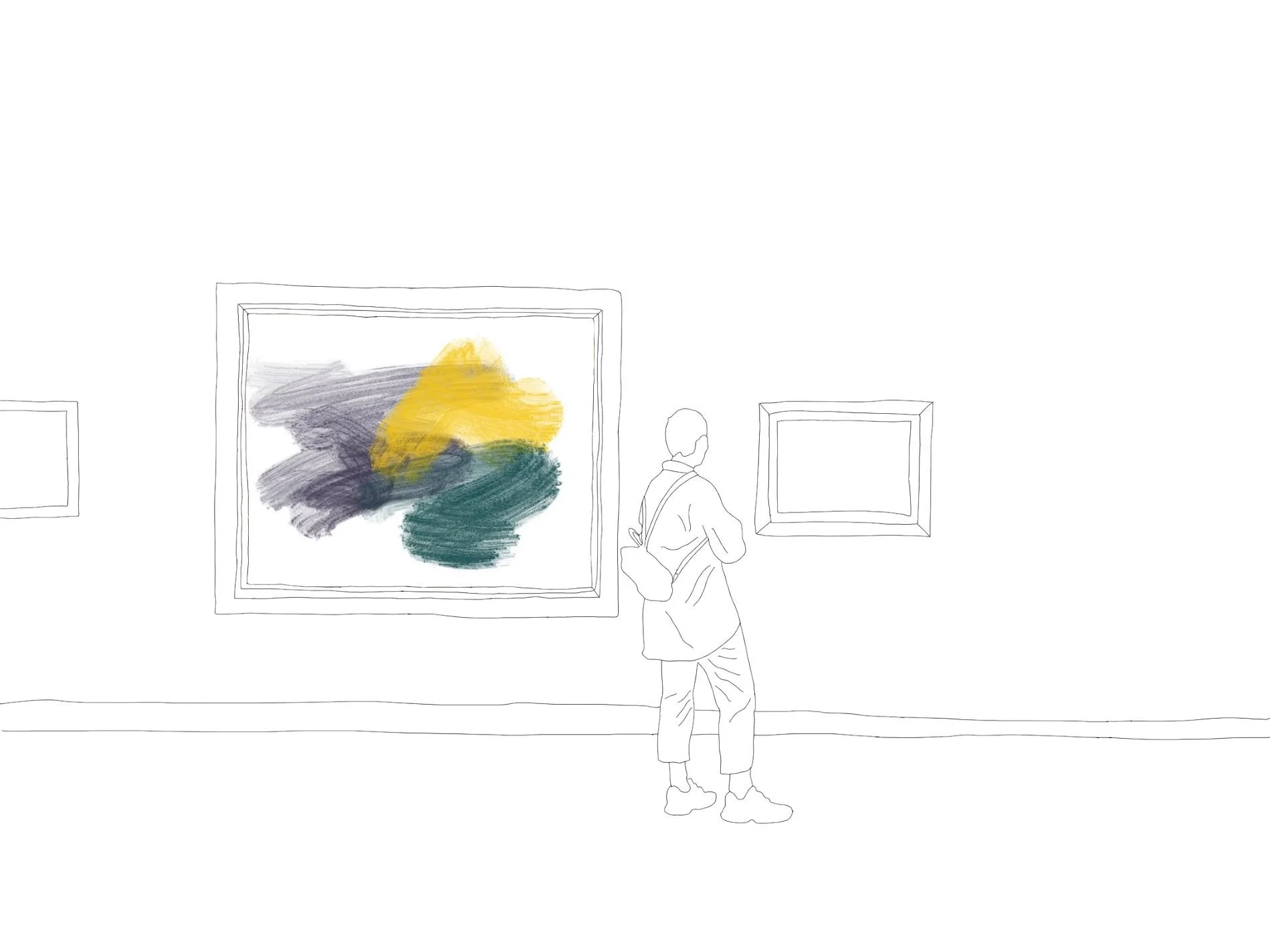
“Canvas” by Hanna Löffler
__________
New Every Morning
Kaeli Joyce
They are new every morning.
Each sunrise arrives with revival—
Each waking with awareness—
Each day with so much fullness—
—revived awareness of the fullness
of disappointments so faithfully
attending Pandemic Time.
They are new every morning,
And they just. won’t. stop.
I keep thinking the disappointments are getting old
and worn out.
Surely they must be tired themselves by now?
I keep thinking I’m now the problem
Refusing to be released from wounds two years old.
But I remember letting them go.
Over and over and over I've let them go.
These aren't old disappointments I'm feeling.
They are tenaciously, now predictably, new every morning.
Maybe this is what Jesus meant by 70 x 7.
We thought that if we released our pain it would stop the
pummelling waves.
Instead it prevents the water from destroying us.
490 disappointments still leave a bruise on the soul.
__________
Introducing [f]ache and pain news: An Interview with Iain Provan
John Davies
Decrying anaesthetic, ignoring screams, [f]ache and pain news drills down into the deepest areas of Regent angst. Journalistic Robin Hoods, we take you laughing all the way to our bank. All [f]ache news items have been rigorously [f]ache[t] checked. Ouch!
This week: We interview Iain Provan about his “high five” retirement plans.
Iain related how he has taken to heart the advice in Regent’s parting gift to him, the book Five Top Tips for Survival in Retirement. These tips are:
#1 Travel
#2 Step Out of Your Comfort Zone
#3 Learn New Hobbies
#4 Volunteer
#5 Write!
He plans to boldly go and combine these into a very literal “high five” with his new hobby of space exploration. Space X have accepted his application as a volunteer. This means he volunteers the necessary cash, whilst they volunteer X. Which is where you come in, as we’re crowdfunding him. Just $50 will buy him a week’s space sandwiches and only $ 5000 a made to measure three-piece space suit and tie. Once in space, he plans to do a spacewalk followed by space prophetic dance (new hobby #2). He will then join the world’s first orbiting space monastery, before parachuting back to earth (new hobby #3a). Although without your contributions, he won’t actually have a parachute ($2000), in which case, new hobby #3b, base jumping. After graffitiing “Regent College” in smoke ($200, new hobby #4) in the Vancouver skies, he will land on a skateboard next to the North Tower, demonstrate his latest tricks (new hobby #5) before effortlessly gliding on it into chapel. There he will deliver a homily: “A Galactic hitch hiker’s guide to Genesis.” This will also be the theme of his book, which fulfils the last of the five tips.
So, Iain has five new hobbies to help him survive until end 2022. “How about surviving 2023?” we asked. He said he’s looking for another five. “Rapping?” we suggested. “Wrapping what?” he asked blankly in his soft Scottish accent, then wrong-footed us completely by breaking into song and gesture: “yo bro, I got mojo.” Hidden talent indeed! We asked what was driving this remarkable transformation. He gazed back dolefully, “you know what I’ll miss most about being a Regent lecturer,” he said wistfully, “it’s the minute-by-minute adrenaline rush. Irreplaceable.” With that underlying aspiration in mind, please send us any suggestions for Ian’s five new hobbies for 2023. Lastly, he said he’d like all Regent students to show solidarity with his new venture by high-fiving him every time they walk past him.
Please contact the EtCetera editorial team if you would like to financially contribute to the Iain Provan retirement fund.
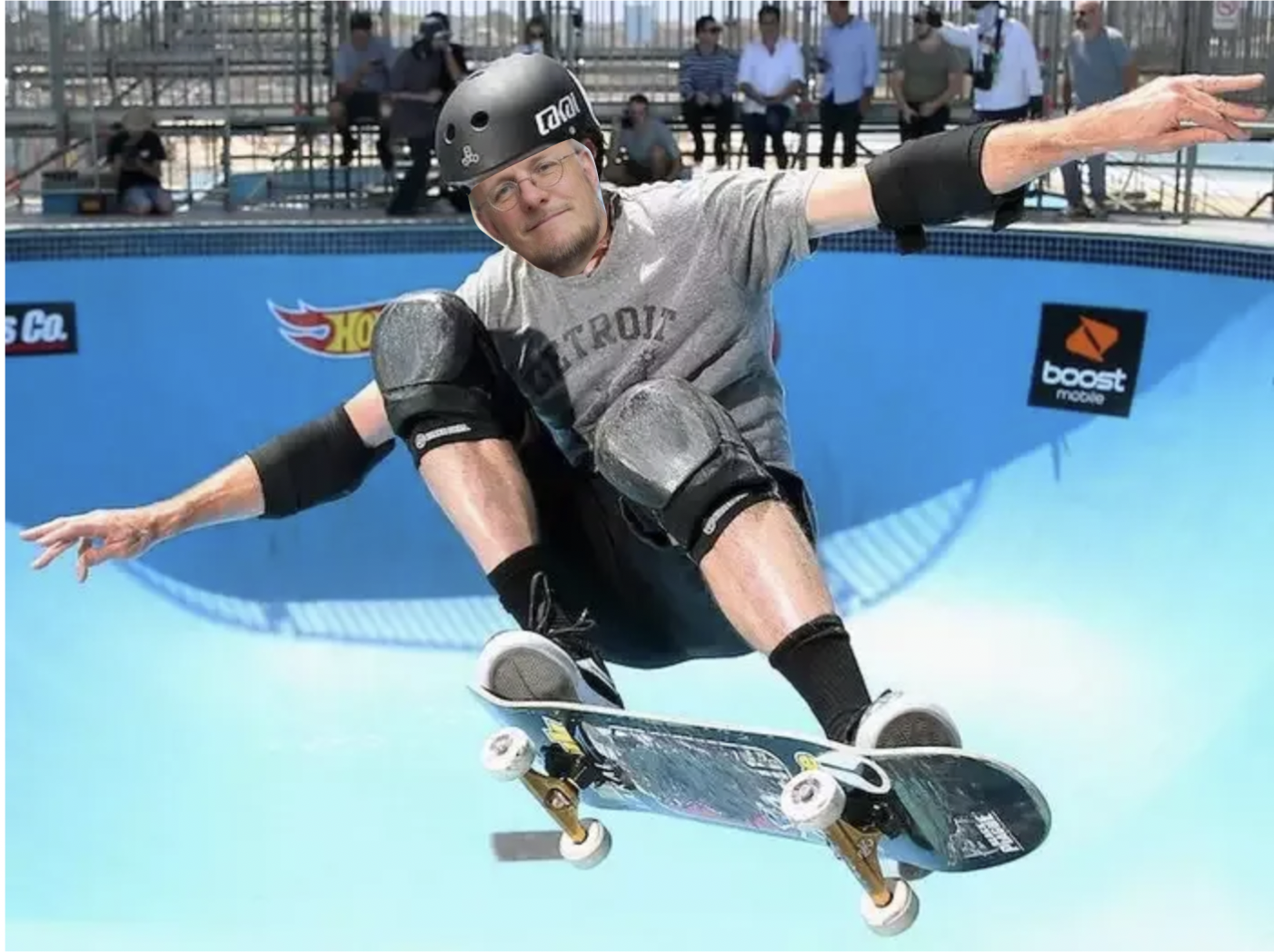
Iain’s sick stunts (photo provided by Tony Hawk).
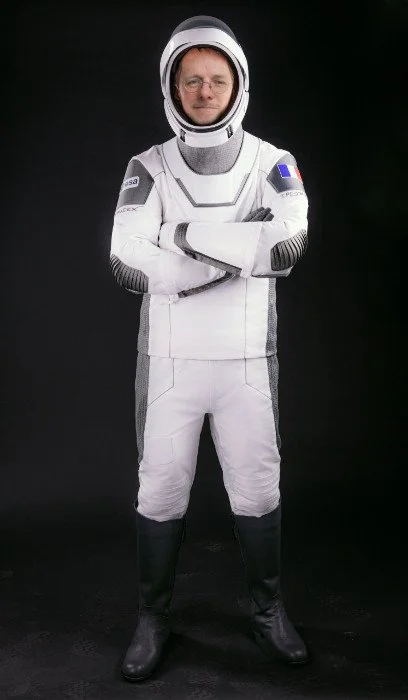
Promotional Image of Iain’s SpaceX flight suit (Photo provided by EtCetera reader Elon Musk).